About Me

My photo
FOLIO is a magazine of strange, comic, and strangely comic words and pictures published from 2006 to 2009. For back issues please contact the_folio@hotmail.com.

Issue No. 6, Pop


Issue No. 6, Pop - Boy Becomes Discman

American Idol was on Wednesday night. I snuck down to Barnes and Noble behind the nation’s back.

I was so happy Italy won the World Cup, I ran straight out and bought a copy of Vogue Italia.

I danced so hard my mirror fogged.

Boy becomes Discman.

Issue No. 6, Pop - Gentlemen, Where Are Your Socks?

“Gentlemen, before we begin, I do have a few words to say about decorum. I was shopping with my daughter for a bathing suit at Target this weekend. I saw a number of you there and more of your person than I’d like. I saw your feet, dried calluses, rising veins – your feet, gentlemen! I understand, as exchequer and exemplar, I may be responsible for this alarming fad. I do remember letting my ankles show once or twice but I will never do it again and, gentlemen, if you value your positions I suggest you fo thr smewq–“

Penelope tired fast of typing. She replaced her Dictaphone headphones with radio ear buds. Johnny Late Riser, her favorite DJ, took the morning shift at KWOW and played her everything she needed to get the blood flowing back to her tips. She flipped through a glossy fashion magazine while she listened, timing the turns of the pages to the symbol crashes in the songs. Soon her licked finger just slid off the corner of the page in a puddle of saliva instead of picking it up, and she returned to another five-minute stint of yesterday’s minutes.

“’Bout time for your lunch, pet,” said the boss, pulling his belt up over his gut as he walked out of the office. “I bet lover boy’s waiting for you right now.”

“Oh yes,” Penelope swooned, “He always waits.”

“Well don’t keep him too long, he’s not getting any better looking waiting in my lobby.”

A cutting comment, but Penelope had been going out with Fon for going on a year and any reservations she might have had at first about his height, skin, and limp were long gone.

“If it’s all the same, I think I’ll listen to the radio a little more. It’s so romantic just knowing he’s down there.”

“Suit yourself,” said the boss, walking back into his office. “The Anniversary Parade meeting’s this afternoon. Look sharp.” The door slam hit a particularly jealous note.

Eventually, Penelope rode the elevator down the bottom fifteen floors of the Renaissance Plaza and there was Fon, a flower made of carrot peels held out in his hand. They walked as they did every lunch hour (the hour between ten and eleven when no one else was out), arm in arm down three blocks to the West Wind Café, a two-table Vietnamese restaurant owned and operated by Fon’s father.


“It getting cloudy today, Pen,” said Fon.

“Certainly doesn’t bode well for the parade,” said Penelope.

“Is bad luck for my question.”

Penelope and Fon took the seat by the window. Penelope powdered her cheeks and Fon relished his time away from bussing tables.

“Stupid boy!” said his father, dropping two menus onto the table. “You take my last carrot flower!”

“Good morning, Mr. Hingtzu,” said Penelope. “I’ll just have the usual.”

Fon grinned and handed back the menus. “The usual.”

Mumbling Vietnamese curses, Mr. Hingtzu threw a towel over his shoulder and went back into the kitchen.

“It been almost a year,” Fon said, taking Penelope’s hand. “I have question for you.”

Penelope cocked her head and looked up at the sky. “Those floats get soggy in the rain,” she said.

“I’m ready to ask my question now.”

Penelope brought her head back. “Question?”


Six captains of industry burst through the door for an early lunch. Together they threw their ties over their shoulders and pounded their silverware against the table.

Mr. Hingtzu ran out of the kitchen, all smiles and menus. “Good morning, my sirs!” He pointed to Fon and snapped his fingers. “Water, now!”

“But…” Fon squeezed Penelope’s hand.

“It’s all right,” said Penelope. “There’s plenty more to type.”

Fon rose and set about pouring water for each of the hogs that took him away from his beloved.

Penelope sat and admired him working for a moment then rose as well, put her compact in her purse and walked back to the office.

“General Tso’s for me,” said a hog. “You listening? I said General Tso’s!”

Fon trembled, a pitcher of water in his hand and a tear welling in his eye. “Will you marry me?” he asked.

The next day and Penelope was hard at work transcribing yesterday’s tapes. “Last year’s parade was a mess! I was humiliated and I damn well hope you sockless bastards were humiliated, too! All in the way of saying, gentlemen, that tomorrow morning we will be having a dress rehearsal! No, gentlemen, I don’t want to hear it, the majorettes will be here and thas anirh tjug–“

Penelope took off her headphones and twirled a pencil between her fingers to get the blood back. She switched on the radio.

“Oh, Johnny. Always the right song at the right time.” She closed her eyes and let her heels slip off.

A good fifteen minutes she spent bobbing and swaying in her chair and she would have danced longer if it weren’t for the fifty majorettes that came walking by her desk and into the boss’s office.


“If he wants to make me jealous, he’ll have to try harder than that,” she said. “I’m sure Fon is coming for me right now.” She got out the Dictaphone and rolled a fresh sheet into the typewriter.

“And that’s another thing, gentlemen. Half our audience was asleep last year. We got to shock, provoke! Think, what’s better than a bunch of batons being thrown up in the air? At tomorrow’s dress rehearsal, we will implement my plans…my plans…is someone going to fix this projector? We will implement my plans at ten o’clock a.m. to fling from this very window dozens of twirling batons like so much ticker tape at the–“

Penelope jumped to her feet and looked to the clock on the wall. Ten o’clock. She let out a childish whimper.

Overcast skies meant nothing to Fon as he waited outside, the perfectly worded question in his best American accent running through his mind and a flower made of ginger peels perfuming his hand. He was the only one on the sidewalk, the only one in the world really, and he felt like bursting into song. He even tried. He spread out his legs and reached out his arms, threw his pimpled, doughy head back and opened his mouth. “Happy Anniversary!” cried the plumed majorettes, and fifty spinning batons fell from the fifteenth floor of the Renaissance Plaza, filling the overcast sky and looking to Fon like the most beautiful constellation, for he could even see, behind the stars, the smiling gods who created them. Then he was pummeled, pummeled dearly.

Issue No. 6, Pop - Norwalk to Manchester


Issue No. 6, Pop - Pretty in Pink Indeed

Andie Walsh worked at a record store called Trax. Her boss, Iona, stapled LP’s to the ceiling as decoration. A child tried to snitch a cassette and Iona shot a staple at him. “This ain’t the public library,” she said.

Mid-eighties Chicago was overcoats and indie rock. School wasn’t school, but being bullied by a rich kid. And work wasn’t work, but sitting behind a counter and turning the pages of a magazine. Andie did that a lot, but I could never figure out which magazine it was.

I know Andie liked fashion, but what music, what movies? She would like the films of the British New Wave, those late-fifties black and white townscapes of kind-hearted young people stuck on the wrong side of the tracks; like Andie, stuck, and the train never comes for London.

Critics argue that for all their contemporaneity, the New Wave filmmakers turned a deaf ear to pop music, relying instead on jazz scores that compromised their progressive intentions with a conservative’s lust for the past.

Funny thing, too, that the New Wave films have no pop music, because where would modern indie music be without the New Wave? Belle and Sebastian’s “The Loneliness of the Middle Distance Runner” from Alan Sillitoe’s The Loneliness of the Long Distance Runner, The Smiths’ “This Night Has Opened My Eyes” from Shelagh Delaney’s A Taste of Honey, the Arctic Monkeys’ “Whatever People Say I Am, That’s What I’m Not” from Alan Sillitoe’s Saturday Night and Sunday Morning.

In the mid-eighties, a sixteen year-old boy named Mark Taylor sorted out connections between pop music and the New Wave cinema for a fanzine he wrote called Smiths Indeed. Staying up late in his Bristol bedroom, he kept his parents awake as he tried to lay out headlines using Letraset on his typewriter.

It’s possible Andie was reading Smiths Indeed when she should have been shelving new seven-inchers. There were posters for the The Smiths all over Trax and Duckie, the poor boy who loved her, listened to the group when it rained.

H.B. Gilmour wrote a novelization of Pretty In Pink in 1988. I’ve worked with the reference librarians at my local public library but we can’t find it anywhere. Still, my nostalgia will not abate and I’ve stolen a typewriter and a record player so I can spend my bedroom nights writing my own novelization. “If you’ve no world of your own,” John Osborne wrote in Look Back in Anger, “it’s rather pleasant to regret the passing of someone else’s.”

Issue No. 6, Pop - This Sporting Life

Issue No. 6, Pop - The Public Library

Issue No. 5, History


Issue No. 5, History - Red Tailed Hawks, 1925


wo remarkable events happened the winter I was fourteen: my Daddy lost his job and Floyd Collins got himself stuck down a cave.

My daddy worked at the tobacconists down by the coal camp and he knew Carl Carlisle since his school days, but all the same, Carl said it was getting tight around the store and he’d have to let him go and he hoped he didn’t mind. At least that’s what Daddy said. Mama was angrier than he was and broke two wooden spoons on the kitchen table and cursed to surprise even me. Daddy just kind of wandered, not walked, out the kitchen door and went down the road without his winter hat. He wasn’t home for dinner and Mama said he could just stay at the Blue Hog as long as he wanted for all she cared but that night she went and got him anyway.

The next day, at school, I heard about Floyd. Mama told the class, “That Collins boy’s missing and they think he’s caught in a cave. This is why your folks don’t want you running around the caves by yourself.”

Some of the boys seemed excited, whispering to each other across the aisle, and some of the girls began to squirm, and Lila, who cried at least once a week in school, began to sniffle. Her voice shook and her nose ran as she asked Mama, “Is he going to die down there?”

“Shush, now. He’ll be just fine. They’ve got men who know every cave in Kentucky out there and the police and Collins family. They’ll probably get him out before the end of the day.” Mama did not look at Lila as she spoke. Mama never looked at you when you cried.


Lydon Hopstreet was one of the best looking boys in eighth grade and Mama liked him all right and I guess so did I.

She told Daddy, “The youngest Hopstreet is sweet on Clemmy.”

He looked at me. “And?”

“He wants to take her out with his family after church,” she said.

Daddy ran his bread heel through the last of the gravy on his plate. “I suppose that’d be fine.”

“I’ll give you something in case they don’t bother for lunch,” Mama told me. She took the bread basket off the table and snapped her hand towel at the crumbs on the table, sending them to the floor.

“He’s a nice boy,” I said to Daddy, guessing.

He nodded and kept his head down.

Daddy was home now during the day and out at night. I used to know how to talk to him after school, after dinner, before bed. But I stopped telling him about school because he didn’t like to hear about Mama’s work. When I saw him, he looked uncomfortable to be around his own house. It made me feel like maybe I should be uncomfortable, too.

He paced the creaky floorboards like the little bear the Doggards kept in a cage by the side of the road. For a nickel, you could walk right up to him and watch him throw his shoulders against the side of the cage to make the cage and you rattle. The bear seemed stronger, and smaller, than I’d expected.


Pastor Olsen rubbed his hands together and took a drink of water. Several babies began to cry.

The church was a one-story farmhouse with the walls between the living room and dining room knocked down to make room for twenty pews. The air inside didn’t move. I shifted in my seat and sighed. I tried to straighten the hem of my dress, which crumpled no matter how many times Mama ironed it. My Sunday dress was fading badly and I began to become a little ashamed of it, especially because Lydon would take me out after. I hoped to find a newer-looking dress at the camp second hand shop, but nothing fit. I was getting fat in the stomach. Pastor Olsen had us pray for Floyd, and for everyone who was lost.

At fourteen, I had already mastered the art of half-paying attention to Pastor Olsen. It got so I only listened when he talked about himself.

“About eleven at night on August eighth, the late Julius Hanson, a neighbor, came to inform us that my sister had been in an accident. One of my parents asked if she was hurt. Mr. Hanson answered, ‘She’s dead.’ Some of the first words my Mother said, in Norwegian, were, ‘Oh, where is her soul?’ It took this tragedy in our home to bring my Mother back to the Holy Father. It became also the means to stir my heart again into the realization of my lostness and my need of deliverance.”

I had buried three tomcats but I’d never had a relative die. Probably just because we didn’t have many, Mama and Daddy being just about the only ones left as far as I knew.

After church, I met Lydon’s family and we all went to see Floyd. I was so happy to be out of the house for a whole day. Lydon’s Uncle Brewster was in town from Louisville and had brought his Model T. Lydon kept elbowing me as he walked towards it, saying, “Not bad, huh?” but it looked like the toys the younger kids at school played with, only gone huge and silly. It was unnaturally shiny. Nothing was shiny in January except, sometimes, the crick when it froze through. Lydon grinned as his uncle pulled down a divider seat for us in the back of the car.

I’d made a honey and butter sandwich that morning and kept it in my coat pocket. I thought I could throw it down to Floyd, who was probably not getting many honey sandwiches. I also brought a comb and powder case I made Mama buy for me, which seemed to try her.

“You’re going to waste my money on that nonsense. At your age,” she said, scowling, as she handed over the money.

Lydon sat next to me and sometimes his knee would bump mine, making my stomach hurt. His mom and aunt sat across from us and didn’t stop talking for a breath till Brewster leaned back and shouted, “We’re here. Will you take a look at this traffic? Looks like half Kentucky showed up.”

“My word,” Lydon’s mother said as she peered out the window. “These buggies need to get out of our way. Honk the horn, Brewster.”

More people were standing outside that hole in the ground than I’d ever seen at the county fair. I couldn’t get close enough to see the hole, much less throw down my sandwich. And the folks ahead of me and Lydon weren’t even talking to Floyd. Far as I could tell, they were talking to each other, and mostly about sports and taxes. There was Bub Former and those two McGuires who used to run the coal camp general store, where folks bought their calico, needles, hangover remedies, salve and any number of elixirs to soothe sooty lungs, all of them talking a mile a minute as if they were still important, as if anyone had to listen to them anymore. Some of the men I recognized by their voices, size, shoulder slopes, by their hands, but their faces looked naked and bleached without a layer of coal dust. Only a few people seemed to remember Floyd was there.

“Why didn’t he tell anyone where he was headed?” a man said.

“Wouldn’t’ve done him any good.”

“Hope he’s got a coat.”

“How long you suppose you could go without food?”

“About six hours.”

Lydon lead me around the outside of the crowd. He asked me if I enjoyed church that day and I asked him how his geography project was going. He said he hadn’t started yet. I said he should consider Egypt. “It’s just deserts and one big river,” I said. We passed a cluster of men around a fiddler and I hoped Floyd couldn’t hear the music.

It was cold and unpleasantly bright that day. Too bright to see, too cold to smell. A blue jay screamed at the trespassers from an ash tree nearby.

Lydon bought me a sock doll with button eyes and a yarn mouth that had Floyd Collins, ’25 stitched onto its chest. So I’d remember. I wondered which inventive town person had come up with that idea. Someone was selling hot tea and someone else had sandwiches. All the people laughing and chattering made me feel restless and wrong. Two men ushered two other men into a buggy parked under a Pignut and in a moment, the visitors left with smothered smiles and two tin cups. Lydon elbowed me again. “Think we should get something to drink?” he asked. I didn’t know how he meant it, so I laughed. He looked handsome when he didn’t have that grin on his face. It made him look like a little boy, apple-cheeked and laughing at some stupid joke. I felt silly standing next to him.
“That’s a Red Tailed Hawk,” Lydon told me, pointing to a vulture who was circling higher and higher until he disappeared.

When we met back up with his family, Lydon’s mother’s cheeks were bright red. “You’ll never guess where that lady was from. Cleveland. Doesn’t that beat all?”

“I think I met a gentleman from Memphis. Probably a businessman,” the aunt said with some tone of authority. "Said nothing can stop money in Tennessee, said sooner or later everyone here's going to move there, land of milk and honey and all that, called us the land of coal and lichen and I told him I don't even know what lichen is. Clementine," the aunt said and looked at me for the first time, "ask your mother what lichen is."

“Your mother,” Lydon’s mother told me, “should take you all here. To learn about caves and not wandering down every hole you see. And to wear a hat,” she said, then looked at the aunt. “I mean, really. No hat. No gloves.”

The aunt nodded her head solemnly, like people did at church. “And can you imagine how his mother must feel?”

“Maybe I should send her something.”

“You’re too thoughtful.” The aunt plucked a pill from her felt skirt and flicked it Lydon-ward. "There's money in lichen, you think?"

“It’ll give me a chance to try that new sweet potato pie recipe.”

“Those army men look so strong,” the aunt said, sighing. The blue jay kept screaming.

“I might join the military,” Lydon told me, “when I’m older.”

“If I ever get stuck down a well or a cave,” his mother announced, “I hope they send those boys after me.”

“I think it’s a shame the police couldn’t do it on their own. Our boys have more important affairs to attend to than the Collins boy. And did you see the redhead soldier? My word.”


The next day, I couldn’t pay attention in school. I got worn out, always being around Mama, at home and at school, and never being around Daddy. I’d drift off during the day, thinking about that man stuck under the ground.

I wondered what songs he was humming to himself and I wondered what songs I would sing if I was in his place. Not Nearer My God to Thee, you can't sing that in the bottom of a cave. Maybe There's a Wideness, Abide With Me, or One Who is All Unfit. Or maybe just one of Clete Hindman's songs about ladies and the Blue Hog and wasn't Gray Hill better when he was young. I thought about how well he was sleeping, if he was sleeping. I also wondered if Daddy would want to see Floyd. Daddy wasn’t having any fun as it was and maybe the trip would be good for him. Show him that someone had it bad, too. And maybe he’d meet a man from a big town who’d give him a job and we could all move away but I wasn’t sure I wanted to go back to the cave. The radio said that morning that the men digging him out had caused a cave-in and blocked the entrance.

Mama yelled at me twice during the day and almost made me stay after school, except that I have to do that every day to wait for her anyway.

On the way home, she walked too quickly for me and I had to skip a step every once and a while to keep up.

She was holding her lips tight together and looked at me and said, “I know what’s been on your mind, lately,” like it was a threat. “It’s Lydon, isn’t it?”

“Not really,” was all I could say. I asked if she’d heard anything about Floyd during the day.

“No, thank God.”

“Why is it taking so long?”

“Because people are incompetent.”

“People?” I asked and looked at my shoes. “You think the army’ll be able to get him out?”

“They’d better. You can’t go without water for more than a week.”

“How long has it been?”

“More than a week. You know,” she said, “I heard an interview with the commander in charge of the scheme. He said they’re on track and that the last cave-in was part of their plan.” Mama rolled her eyes. She had embarrassingly little faith in the police or the army. That summer, the police wouldn’t charge our neighbor, Tom Salks, for shooting our beagle, Elmira. And the firemen, she says, let our barn burn down because we didn’t go to the dance they have every year. I’m not sure what she had against the army, but she sure didn’t seem to think much of them either.

“I prayed for Floyd last night,” I told her.

“Me, too.”

“You think he’ll be okay?” She didn’t answer. “Cause why pray if you don’t?” I said, a little nervous.

She stepped over a slush pile and said, “Try not to ruin your dress, will you?”


We kept the radio on all night at home, and Mama even put it on at recess. It became useful at home, because no one had to speak at dinner. We’d sit there, staring at the box like we could understand the voices better by looking at it. Mostly it was Floyd, but also there were crop estimates for the next year and harvest, general coal outrage, and, sometimes, a storywriter would come on and read us something. One was a true story about a man who saved his family and the neighbors from a bear by beating him to death with an axe handle. Sometimes, Lydon would come over for dinner. Then we’d talk some. I could tell that Lydon didn’t much like talking to his teacher at the dinner table and that Daddy seemed to frighten him. Seeing Lydon next to Daddy made Lydon look like a chubby, sleepy baby and Daddy like a lumberjack.

“You should’ve seen him before, though,” I told Lydon one night after dinner.

“Before what?”

I didn’t want to tell him. “Before winter. Before Floyd. You’ll like him better in the spring,” I said.

Lydon stretched. “I can’t wait for spring.”

“Me neither.”

“I’m gonna try out for the baseball team. Think I’ll make it?”

“Sure,” I said. “Yes.”

“Dinner was good. I love pork chops.”

“Yes,” I said.

A door shut and a wave of cold air rushed through the living room. “Was that your Dad?”

“Yes.” I began to feel as if I didn’t have to answer for Lydon to continue.

Daddy left after dinner, always, and it got so I didn’t like having Lydon over. He told me he thought it was strange Daddy didn’t stay and maybe I did, too.

Girls like Alice Ians or Greta Tomshaw’d giggle and ask me if Lydon’d kissed me and wanted to know everything about where we went and what we said to each other. I didn’t know what to tell them. “He’s all right, I guess,” was all I came up with.


One day, Lydon walked me home from school and we hung back a block or so from Mama. He asked me about the poem we had to memorize, and if I’d chosen one yet. I said no, that I didn’t feel like reading poetry in front of the whole class and he said, “I know what you mean.”

Then he asked if I heard anything about Floyd and I said no. He said Greta Tomshaw had passed him a note and wanted to know what we were up to. He said I looked pretty that day. Then he said his brother and Evelyn Williams were going to get married so they could see each other naked and kiss and touch each other. He talked about it long enough that I got the hint.

“I just don’t think I could,” I said. I was quiet for a long time and I scrunched my mouth from one side to the other and kicked some rocks out of my path. It took about a minute of that before he kicked a water pump and cut through the Neckers’ yard.

I had to run to catch up with Mama.


Mama was cleaning the table when the radioman began talking, loud and rushed. “On the eighteenth day of the Floyd Collins crisis, we have an update,” he began.

The army men had found a new route after the one caved in, and they had reached Floyd, three days dead. Mama set down the bowl of potatoes on the table and looked at Daddy, who was halfway out the door. He stood there, letting the winter air fill the room.

“Fools,” Mama said in her spiteful voice and crossed herself. “Bickering, arrogant fools.”

I didn’t know what to say. I was a little glad he got to die in private. If he’d been rescued, what would he say to the crowd? To the man selling sandwiches?

Daddy pulled out a chair and Mama shut the door. He slumped like someone let the air of his chest.

“I can’t believe it,” Daddy said. He held his head in his hands. Mama stood behind him and put her worn hands on his shoulders. I looked away because I didn’t want to see him cry.

“I just can’t believe it,” he said. I could. And I was only surprised that I wasn’t surprised.

Issue No. 5, History - The Diary of a Country Priest

Childhood grown old.

*

Things change. Sensitive parents have suggested I lead my Sunday school class in prayer to Gosh.

*

A letter from a Methodist preacher in Rome: “YOU feel out of place? I’m as invisible as God. They have no sense of time here. They think it’s evil, that it comes from Times Square.”

*

The walls around the pool of wax inside my Glade scented candle look like the catacombs of the primitive church.

*

There is a finite amount of gold in the world. The same amount that existed two millennia ago exists today. Imagine my surprise when, picking the wax out of my ears, two flecks of gold leaf fell out onto my desk. I set to work immediately on the halo of an icon.

*

There isn't a child younger than me!

Issue No. 5, History - Come and Go


Teresa McGarry, a toothy, handsome 74 year-old, tells me of her mother, Mary, walking 11 miles to town and coming back with a "hi-fi" on her back. Hi-fi? I wonder, before realizing she means a phonograph. Mary delivered her daughter Margaret the next day. Margaret muses that this must explain her affinity for music. Margaret, Teresa, and Agnes were the last of 11 children born of Mary and Anthony McGarry in a small village in Ireland. These three girls grew up together and moved to the United States in the late nineteen-fifties.

When asked how they saw their future they all respond, "I didn't think about it.” Apparently, there wasn't much time for daydreaming. "When we came home we had a lot of work to do," including chores, helping in their mother’s store, and tending the potatoes. “Oh the potatoes, I hated that!" exclaims Margaret. They toyed with being nurses (as their older sisters were), but the one option they never considered was staying put and living out the lives of their parents. Though not for any want of happiness. Despite their work and chores, "We had a lot of fun, too" insists Agnes. After fifty years, the memory of dances and socials still excites the girls and makes them laugh. "It was during the war and nylons were especially hard to find...There was nothing we wouldn't do for a pair of nylons to wear to the dance." (“We didn’t have the thongs of today,” Agnes adds later). Margaret, when asked to describe her first husband, whom she married before she was 25, can only muster that he was "a good dancer."

None of their marriages seem to have modeled themselves after their parents’. Teresa, who confesses to not having wanted to get married, tells me of her husband’s vices: “the jealousy is worse than the drinking. I hit the jackpot and I got both.” That marriage, which ended in a bitter divorce, seems to have soured Teresa on men in general––except priests, with whom she spent the majority of her life while working in rectories. She did have a boyfriend in her sixties, a rather wealthy man who seems to have been quite nice to her, but Agnes tells me on the sly that he was definitively “sexless,” if not “gay,” and this was the reason Teresa felt so comfortable with him.

Margaret’s marriage, too, was plagued by jealousy. “If someone even said hello to me, whooo.” Her husband––the dancer–– was a hard-working man with a penchant for smoking, which killed him, and wanderlust, which kept him from being happy. “He wanted to be in control,” Margaret told me. But once he became sick he had to trust her or accept his fears. Not long after his early death in 1982, Margaret used the money from his insurance to set up a beauty salon.

One anecdote the girls seem to relish sticks out in my mind. When they were children, the British sent a rough and untrained military force, called the Black and Tans, to tame the Irish. These men were of dubious moral standing and felt free in the countryside to take what they wanted, as one did when he entered the McGarry home. Mary stopped him and declared that he was not to go into the girls’ bedroom. Brushing her aside, he found himself unable to move. His foot had been pinned to the floor by a pitchfork. Mary was summarily arrested and charged with ‘Obstructing a gentleman.’ The judge imposed a fine, which she refused to pay, denying any wrongdoing. Her husband Anthony “must have gone through hell,” because he did pay his wife‘s fine, slowly and secretly.

Issue No. 5, History - There isn't a child younger than me!

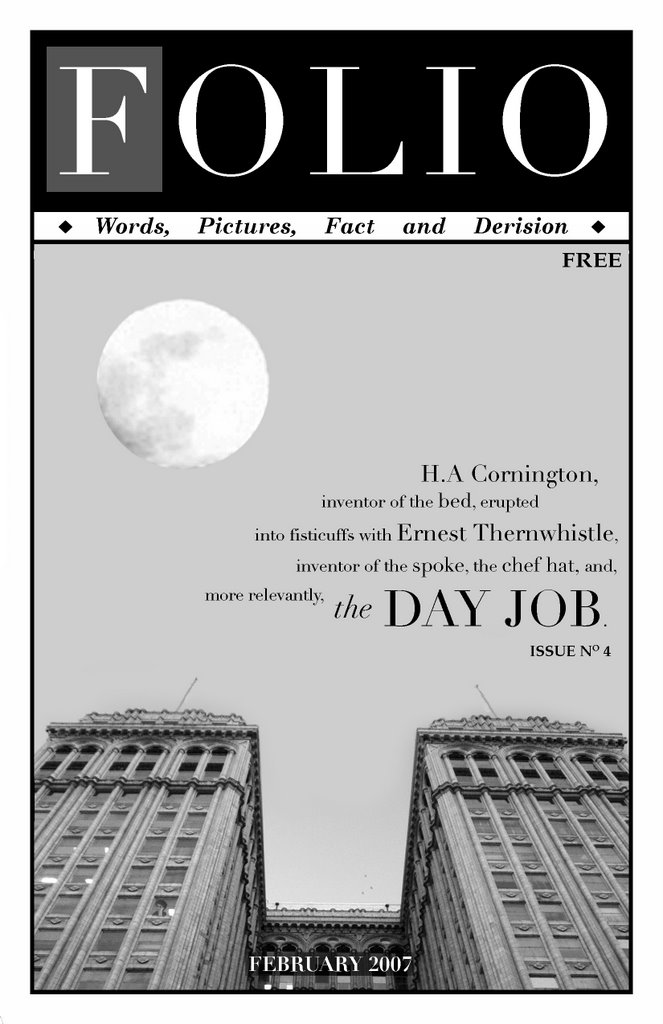
Issue No. 4, The Day Job


Issue No. 4, The Day Job - The Shoppe


A polite young man from the San Fernando Valley phoned the shoppe one rainy morning and held it up. Rain kills business, so they say, and so it did, all morning. Which is not to say it was a particularly bad morning. I do enjoy the quiet time, savoring the potpourri and thumbing through my Reader’s Digest. A woman eventually did come in, a tad severe in her demeanor, but I didn’t judge. She walked directly to the glass case beneath the register, to our most precious of Moments, the newlyweds and graduates we keep under lock and key.

“I’ll take this one,” she said.

“The little boy with the chocolate smeared on his face! How lovely!” I climbed down from my chair and opened the case. “Would you like this wrapped today? Why don’t you try some of our biscuits there and I’ll get this all wrapped up.”

“Thank you, I will.”

“This must be for someone very special, I can—”

“Jeanette! Jeanette!” Lisa, our newest part-timer, came running out of the back office with the phone. “There’s someone on line one who wants our money!”

“Lisa, I’m with a customer at the moment, it’ll just be a sec.”

“He says it’s a stickup and we need to send him all our money!”

“These biscuits are good,” said the severe-looking woman.

“Aren’t they? That’s real apricot—take another. Lisa, could you wrap this figurine for me?”

Lisa came over, sweating more than I’d like, and I took the phone. “Rosebud Gifts, this is Jeanette, could you hold for one moment? Lisa, the bows are in the drawer. That’s it, the blue one. Yes?”

“Send me all your money.” The words were direct enough but the voice was soft, shy, inviting of a conversation even if the young man on the other side didn’t seem to want one.

“My, oh my! Who may I ask is calling?”

“Nevermind who’s calling. Send me all your money.”

“Yes, sir, of course. I’ve never been held up before so—hold on a sec. Thanks for coming in! Enjoy your miniaturette! Sorry. I’ve never been held up before so you’ll have to walk me through this. Although I did imagine if it were to happen, it would happen in person.”

“I’d get caught if I did it in person.”

“Yes, I suppose you would.”

“And now you can’t call the police ‘cause the line’s tied up.”

“Very clever.”

“Go get an envelope.”

“Ok. A business-sized envelope?”

“The biggest you’ve got.”

“Lisa, go into the back office and get one of the manilas.”

“Wait—is there someone else with you?”

“Yes, I always work with Lisa on Thursdays.”

“Well, tell her to get down—and with her hands behind her back.”

“Lisa, the young man wants you to lie down. If you could just grab one of those manilas and then lie down—and with your hands behind your back.”

“Now empty your till.”

“Let’s see, I’m not sure how to enter this in. Shall we just say it’s a No Sale and I’m getting you quarters?”

“Just take out the money!”

“Right, I’ve got the envelope.”

“Good. Put all the money in it.”

“All of it? Gosh.” I had Lisa hold the manila above her head while I shook the drawer into it. “Alrightey, it’s all in there.”

“Seal it up. And address it.”

“Will do. Just have to find a pen. I’m addressing this to—who am I addressing this to?”

“To—damnit! Evan Kowalski.”

“Evan! I almost named my son Evan.”

“24 Orange Grove Place. Woodland Hills, CA. 91302.”

“Wood…land…Hills. CA. CA? That’s in California!”

“Yes.”

“That’s the other side of the country!”

“I can’t hold up a shop in my own town!”

“No, but California. Wow. Where in California are you?”

“The San Fernando Valley.”


“Well I’ll be. You know I have a son-in-law comes from that area. I’ve never been myself. Is the sun everything they say it is?”

“Did you address the envelope?!”

“What do you do down there in the San Fernando Valley?”

“…I’m a student.”

“Oh, how wonderful. What is your area of study?”

“Botany.”

“Fascinating! And do you know what you want to do after you graduate?”

“No.”

“Well, that’s fine. You know, I didn’t know what I wanted to do when I was—”

“My health insurance runs out.”

“—your age and everything worked out just fine so don’t you worry.”

“My health insurance runs out.”

“What’s that?”

“When I graduate, next month, there’s no more health insurance.”

“Oh, companies normally take care of that sort of thing. I remember when I—”

“Do you know of any openings for a botanist?”

“Well…”

“I get sick all the time. They’re about to kick me out on the street and I’m gonna get sick!”

“There must free clinics in the San Fernando Valley.”

“I’ve been coddled and mollycoddled and now it’s skid row, the cold nights, the whores, the hypodermics, and all without health insurance!”

“No, that doesn’t sound good.”

“Not to mention the shelter and food I used to get. Where is it now? I need money!”

“Have you thought about teaching?”

“Don’t try making up excuses and giving me advice.”

“Sorry.”

“All this future living, it’s blind tightrope walking! They gave me a line, it moves forward and forward, over and ever forward and suddenly, at the drop of a hat, they’re taking the net! I’m falling and the only thing provided is the cement floor that turns my body into a half-inch layer of blood and crushed bone! And no health insurance!”

“I’m sorry.” I was touched

“Put it in overnight,” and the young man hung up.

The electronic chimes went off and another woman, not as severe as the one before but similar capris, came into the shoppe. “I’m looking for a figurine,” she said, “it’s a little boy, his face is covered in chocolate?”

Dazed, I said, “What? Chocolate? Oh no, I’m afraid we just sold that one.”

“Shoot. That’s too bad. Why is that woman on the floor?”

“Hmm? Oh, Lisa, get up. Run this envelope through the postage machine. Is there any thing else I can help you with today?
“I’ll take a quick spin around.”

“Jeanette! The envelope’s too big, it won’t fit!”

“Just put stamps on it!”

“How many?”

“All of them!”

“Are these soaps handcrafted?” asked the woman.

“We’re out of stamps!” screamed Lisa.

“Soaps? Uh, yes, I think so. How can we be out of stamps?”

“You two sure are busy today.”

“We were robbed. Um, can you go to the post office?”

“Robbed! Did anyone get hurt?”

“No, he did it over the phone.”

“There’s no time for the post office! He’ll call back!”

“I don’t understand. Over the phone?”

Lisa was jumping up and down. “What do we do? What do we do?”

“Yes,” I said. “From California.”

“California! Well, don’t send it!”

“What?”

“He’ll come to our windows at night!”

“And he was so polite! We have to send it!”

“He’ll look at us through our windows at night!”

“Suit yourself. I do like these soaps.”

The electronic chimes went off again. A woman dragged her sons inside. They started running around, touching things. I looked to Lisa. She still had the package in her hand.
“Excuse me,” a woman approached me, “I saw a card in here a couple weeks ago. There might have a dog on it. Do you still have that one? Douglas! Did you-? If my boys break anything, what is your policy on that?”

“Well…”

Lisa slid the envelope under the counter and bit her lip. I bit my lip. We walked onto the floor and helped our customers—so much for the rain.

We take the phone off the hook now. The envelope is still under the counter. Our till is filled with new money. But something is missing. The shoppe moves on, over and ever on, but something like the floor is missing.

Issue No. 4, The Day Job - Questionnaire


-What did you do in your previous occupation?
-Sully.

-What do you and your wife do for fun?
-Switch bunks.

-What is the best advice you have ever received?
-Good things come to those who nap.

-What advice would you have for your employees?
-Each deed procrastinates the next. There is nothing more ridiculous than effort.

Issue No. 4, The Day Job - Ask-A-Librarian


Two stout bottles of physic when Frank of Reference opened his mirror. Both of equal shape and size, both topped with stained, upturned cups, but the stains of each of different colors; one a sunny orange, the other a nightshade green. Frank, confusing the image of the two bottles with the prior of his face, reached out and unscrewed his eye—his green eye.

“Marco!”

Dorothy rose to the counter after hiking up her grandmother’s stockings. Nearly grandmother-age herself, the stockings had a tendency to curdle. “Hello, Thomas. How are you this morning?”

“Hey! Where’s Frank?”

Dorothy swiveled to the hand lotion, worked the squirt into her palms, and searched for a title on her computer, all the while able to engage Thomas without speaking directly to the knobby buzz cut only just clearing the counter. “I don’t think Frank has come in yet, Thomas.”

“We were supposed to play our game!”

“The library doesn’t allow Marco Polo in the stacks.”

“Frank lets me!”

“I know you ask him every morning.”

“We were going to play today!” Thomas sat up on the chair beside the counter. He looked around at the homeless, jobless, and foreign slowly filling the library. “Tell me when Frank is here,” he said and stumbled off towards his daily books and computers.

Frank’s bedside phone and not the noonday sun finally woke him.

“Good morning, Frank. This is Dorothy at the—”

“Dorothy—what time is it?”

“It’s twelve-thirty. I was just looking at—”

“Dorothy…” Frank attempted to prop himself up on the headrest but fell back into his pillow. “I think I’m gonna have to call in sick today. Do you mind handling the desk by yourself? I’m feeling really…tired.”

“No, it’s ok, Frank. I was just looking at the schedule and it says you’re slotted for Ask-A-Librarian duty anyway. So as long as you have your computer on, have a nice afternoon.”

“Ok. Wait. What’s Ask-A-Librarian?”

“You were at the last meeting. It’s a feature on the website where people can ask a reference librarian questions from their home or work computer.”

“Ok.”

“All right then, I’ll see you tomorrow, Frank.”

“Ok,” but Frank was mostly back in sleep by then. The receiver slid down his chest and off the bed, tipping the bottle of original flavor Nyquil from his nightstand. It landed on the carpet and began its slow drip-drip, the final drop joining the puddle hours later.

Frank woke of his own volition to see his alarm clock inching towards four. He felt unusually rested but the guilt caused by that first sight of clock sank in and threatened to unrest. The days were short that time of year and four meant end, not tea.

He swung his legs over the side of the bed, hoping the brisk movement would counter the guilt. He smiled, resolved not to waste daylight on a shower and mustache-trimming, not even a proper dress, and rounded quarter-to down to half-past, effectively changing four to three.

He greeted the kitchen yawning “Carpe diem,” slippers squeaking and the untied ties of his bathrobe trailing behind.

“Oh no,” he said, noticing a houseplant he was particularly fond of, the only house plant in the house, stuck in the shade. He thought the kitchen would have been a perfect spot for the plant to receive sun. But this being his first afternoon at home in the thirty-some years he lived there, he had never been around to notice the repercussions of a northward- facing kitchen.

He took the plant out of its dark corner and carried it, whispering an apology, to the study, where a fulsome pool of sun was collecting on the floor. He primped a few leaves and patted the soil, but a beep—quite unlike the usual ones—suddenly let out from above. He followed the beep to a new window displayed on his computer, on top of the regular library website.

The window resembled a chat room, something Frank was familiar with from late nights chewing fat with likeminded science fiction fans. At the top of the page, from a gigglypuff98, “Marco!”

Frank smiled, typed, “Afternoon Thomas. Hope you’re staying out of trouble.”

He was surprised by his child friend’s inordinately nimble fingers when—before he could even give a second glance to his favorite houseplant—a reply was posted. “Currently drowning in bad research for an expansive novel I’ve been planning for years, historical fiction, and need desperately any and all material relating to eponymous explorer Marco Polo. Only I am homebound, stricken with a terrible case of fatigue. But if you could reply, with call numbers and, of more importance, directions to those numbers on your shelves, I will gladly retrieve the books as soon as I am halfway awake.”

Frank read the post over twice. “Thomas?” he eventually replied.

“Doctor (née Tank Engine),” was the immediate response.

The plant was then sadly absent from Frank’s at first groggy and now groggy and puzzled mind. He compared the prolix post with the juvenile name and considered the impossibility of little trend-diagnosed Thomas ever composing a consistent sentence.

Frank typed: “You’ll find all non-fiction material concerning Voyage and Travel in the early to mid 900’s. We also shelve biographies in that general area.”

“Which general area is that?” popped up.

Frank replied, “All non-fiction is stored on the first floor, the 900’s—” but another post came up before Frank had finished typing.

“This is the Jefferson branch, correct? I’m afraid I live too far away from the main library (though my kid makes me drive out there enough).”

The kid would explain the screen name, Frank thought. “That is correct. The old building off Main Ave.”


“Is that before or after the Cold Stone Creamery?”

“Before, if you’re coming from the south.”

“I’ll be driving from the north.”

“In that case, the library will be on your right, just after the Cold Stone Creamery.”

“And where in the library are the 900’s?”

“All non-fiction is stored on the first floor, the 900’s are in the southwest corner of the building. They occupy the last shelving unit before the artificial ferns.”

“Would the materials be on my right or my left as I enter the aisle between the shelves?”

“Coming from the side of the ferns or from the windows?”

“That’s the windows that look out onto the river?”

“The windows that look out onto the parking lot.”

“The ferns.”

“The left. And you’ll have to crouch. The Marco Polo material will run the length of the bottom shelf of the first column.”

“I have a bad knee. Will there be anyone at the library who could pull the books for me?”

“Yes. Anyone at the reference desk would be happy to help.”

“Where would I find the reference desk in relation to the southwest shelves?”

“Directly behind you.” Frank cracked his knuckles and looked down to his plant. The sun had left in favor of a sliver of wallpaper on the opposite side of the room. Frank turned on the light beside the computer, and returned to the keyboard. “We also have several picture books on the life and travels of Marco Polo in the children’s section, if that would interest you.”

“Where’s the children’s section?” predictably.

“Second story. Look for the B’s, B for biography—after, that is, the J for Juvenile. Alphabetical by subject.”

“No. I don’t think I’ll be making it up there. Bad knee.”

“We have elevators. Second right after the ferns.”

“Thank you very much. This is quite a service.”

“Good luck on your novel.”

“If I can ever get out of bed…”

“How long have you been tired for?”

“Feels like always.”

“I’ve been drowsy all day today. I’m actually typing this from home. Slept sinfully in, I’m afraid.”

“No harm done. What’s the culprit?”

“Woke with a sore throat but took Nyquil instead of Dayquil.”

“Dayquil’s the orange stuff.”

“Yes. But I enjoy being at home.”

“It’s a different world, home in the business hours.”

“The sun’s gone done.”

“Too bad.”

“This would be close to my bed time, after a long day of work.”

“You worked.”

“I did. Does that mean the day is over?”

“Yes.”

“Over.”

“Over and done with and out.”


Dorothy’s stockings bunched around her toes as she ran alongside a group of security guards, policemen, and firemen over thousands of toppled books. Patrons were huddled in a frightened circle beside the newspapers. The computers were consumed in flames and had set the sprinklers off. Thomas was high on the shelves, laughing, pushing them over and onto the guards as he leapt from one to another. He teetered over the edge of the last shelf, fake ferns far below him. He looked to the right, at the windows and the parking lot. He looked back to Dorothy, gaining on him. He ran head first into the window, making it halfway out before a cop jerked him back by the foot. The glass cut into his chest and blood ran down the policemen’s arm. Still, Thomas laughed, and kicking his feet and punching the glass, screamed, “Polo!”

Issue No. 4, The Day Job - Anais Nin From Nine to Five

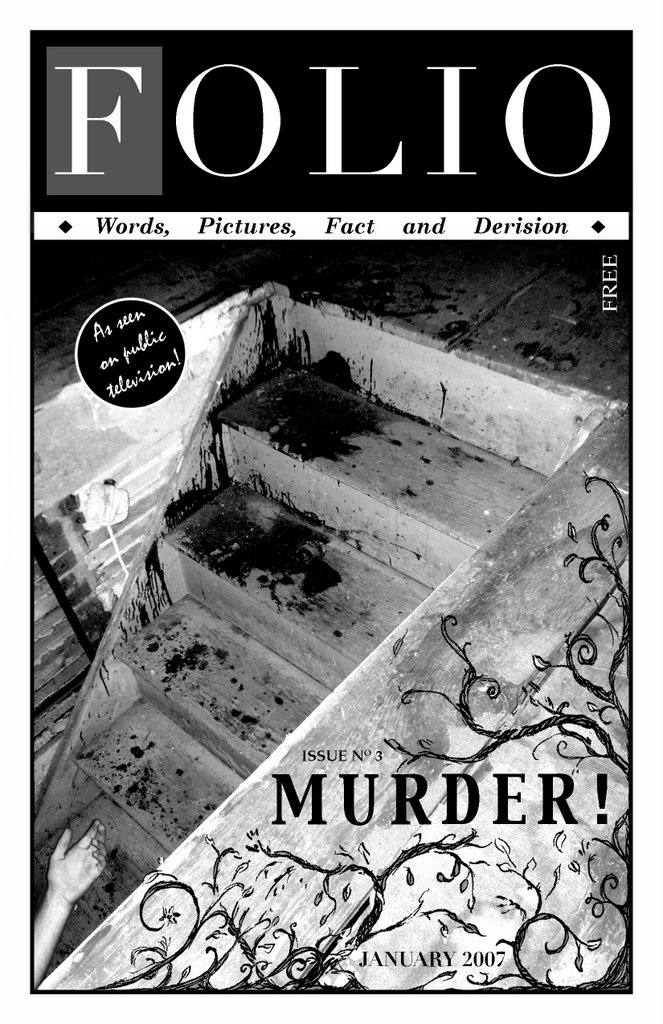
Issue No. 3, Murder!

Issue No. 3, Murder! - Young Life: A Nathan McMurphy Mystery, Part I

I was reached for the morning I had spent all week dreaming of, the Saturday morning I was to float downstairs mid-afternoon and greet my parents’ cries of “This is how you take advantage of your youth? You’ve wasted the day! Your breakfast, lunch, and dinner’s cold! We were going to take you to the movies but you can sure as hell forget about that!” with a calm, face-to-the-fridge, “Sorry, I dreamt in.”

I was reached for and thrown into the shower before the migrant leaf blowers had even wiped the sleep from their eyes. I reminded myself whilst dressing in yesterday’s corduroys to bring my pillow along so I could continue in the car, but I was called for and forgot. I sat back--my head on the folded-down armrest--watched the dew fly off the window, and called to mind mass homicide(1) .

Weekends arrive and tireless parents are never content to stop moving--they daytrip. Every state park, historical mansion, colonial village, art museum and arts and crafts museum has been trod upon by my parents and me on at least one Saturday afternoon. They were on a college campus kick, visiting every one, doing the same things at each: the library, the galleries, the dorms, the quads, the disparaging comparisons to their own alma maters. The went to remind themselves of the youth they had lost, not my awkward, lumpy, sixth-grade youth, but university youth--lithe, pale, and in all senses upwards.

The general feeling walking amongst such budding gods and goddesses was of overwhelming self-disgust. I, a pustule of a boy, trailed my parents under the age-old oaks and stone halls with all the anger and hatred that seethes from ugliness like the acne from my sweating, rubbing inner thighs. The feeling was not foreign, but was inflamed amidst people on their sexual peak. Had my parents brought me just to inflame me? Had my parents had me just to inflame me? I had to pee.

“Guys! Mom! Can we stop?” I made the plaintive plea trying to catch up through miles of topless volleyball and mud wrestling, careful my volume did not attract attention. Eventually, I did catch up enough to accidentally step on my mother’s bare heel. She turned back fast, her eyes tearing from the pain. She pointed to a three-story Georgian home across the street.

“Piss in there!” she said.

“I think I can hold it.”

“Piss in there!”

I kept the imposing edifice in view as I walked under a banner with strange letters, Greek to me. At the stoop I turned back and saw my parents continuing down the sidewalk. I thought, rather than run after them, I had better pee first.

The door was open. I saw no one in the foyer. I walked down the hall and peered into the keyholes of all the shut doors. Whatever the rooms were--I saw only crushed papers and soiled undershirts-- they were not restrooms. The hall took me to a staircase and, it being my only choice, I took it. I peered my way down another row of closed doors until I finally came upon a toilet. I shut the door behind me, tried to lock it, failed, and went.

It was an old toilet, involving an arcane system of pulleys and chains. I must have pulled the wrong pulley, or perhaps I wasn’t supposed to pull anything, but the box on the ceiling came crashing to my feet, cracking to pieces and soaking my Airwalks. I did my best to collect the porcelain into a neat pile. I turned on the fan to dry the floor and left the bathroom redder than I arrived.

An older boy passed as I stepped into the hall. He was like the rest of them, an inspiration to mannequins everywhere, but he shot me a very worried look. He walked fast, was down the stairs by the time I noticed the toilet water seeping out from under the door.

I heard voices and sirens; they got louder as I got closer to the bottom of the stairs. I wasn’t sure the floor I walked down to was even the floor I first walked into, it held so many people. Most were university youth, others policemen. A band of caution tape blocked off the stairs from the crowd. They must not have figured someone as young as I would have been in the house since I was able to walk quite comfortably under the tape.


Slipping in eye level with the older groins around me, I noticed all were facing the same direction and--slipping in that direction--I found a small clearing in the center of the hall, in the center of which was the body of a young man, alike in all physical respects to the standing bodies around it, but dead. Two policemen stood closest to the body, one at each outstretched arm.

“Do you think it’s another one?” said one to the other.

“There’s one sure way to find out,” said the other to the one.

He knelt beside the body’s chest, to a tear in its sweater. He pulled the tear apart, revealing a wound, and pulled the wound apart. A translucent liquid, bubbled, poured out of the gash and onto the floor, pouring until all that was left of the chest was a standing ribcage. The policeman closed the wound, ordered a bandage, and the leak ceased. He looked up to his partner.

“Yup,” he said. “It’s Pellegrino.”

I remembered my parents. I slipped my way back to the front door, feeling like a snorkler caught in so many jelly fish he didn’t know which way was surface. I found, after finally making it to the front, my problems of navigation were caused by the sudden fact that no light was coming from the open doorway. The bright Saturday daytripping weather had turned. It wasn’t raining, but the sky was so overcast one couldn’t help but imagine it was.

Having set off in the direction my parents walked off in, I was admiring a marble globe outside the planetarium when a very fat woman intercepted my path and grabbed me by the neck. Her apparel was as one would expect from a fat woman: sweat, and too small. The only remarkable characteristic, aside from the violent greeting, was a silver, shoulder-length wig, too silver to pass for real and yet even too silver to make for a sensible costume. I paid enough mind to what she was saying--though the dried Chef Boyardee in the nooks of her lips was distracting--to at least hear, in a nasal British, “Very like a murderer to calmly leave the scene.”

Despite my loudly-stated intentions of finding my parents, the woman in the wig turned me around and carried me back to the old Georgian house.

to be continued…

Issue No. 3, Murder! - Footnote #1, Nathan's Fantasies


A child is asked, “Would you ever like to kill someone?” The child rolls his feet to their sides and pulls on his fingers. “Sure.”

The secretary’s long, auburn-dyed hair was pulled and taped to the front of her desk, the secretary lying face up on her blotter. A pair of scissors were taken out of her pencil jar, raised with both hands and driven into her forehead, then again between her eyes. Her cheeks, her nose, her mouth were stabbed. A family member later called to identify the body said the face was nothing more than “a bowl of marina sauce,” although her blouse and woolen skirt ended spotless.

I watched the tiny, white waves cover the toddler’s face. His mother punched me in the gut and dove into the hot tub after him. I was expelled from my hotel.

The living tend to blend in, except when they’re ripped open. Blood lets everyone know that living is something different.